Foshan, Guangdong, China [email protected]
0%

Choosing the best Aluminium Entry Door supplier in China requires more than comparing catalog prices. A polished website can hide weak profiles, inconsistent finishes, or poor installation guidance. The better question is practical: which supplier can deliver a secure, weather-resistant door repeatedly?

Gary Katz, a veteran door and hardware consultant, has said, “A door is only as good as its installation.” That observation matters in every supplier review. A strong factory should explain its alloy grade, thermal-break design, powder-coating process, glass options, locks, hinges, and testing methods. It should also provide clear drawings, realistic lead times, factory photographs, and verifiable project references. Ask for samples.

Look closely.

A reliable Aluminium Entry Door manufacturer should welcome technical questions. It should not avoid discussions about air leakage, water resistance, wind pressure, or hardware replacement. Experienced buyers can request coating samples and inspect corner joints, drainage paths, gasket compression, and frame alignment. These small details become obvious when rain strikes an entrance.

Our first shortlist may seem convincing, but photographs are not proof. Factory audits, independent inspection, and documented quality procedures provide stronger evidence. Certifications can help, although they should be checked for scope and validity. After-sales support also deserves attention, especially when doors are shipped overseas.

No supplier is perfect. Some may offer excellent engineering but slower customization. Others may provide fast production while using less adaptable hardware. The best choice depends on climate, building type, budget, and service expectations. This guide compares those trade-offs carefully, helping buyers identify a capable Chinese supplier rather than simply the cheapest one.
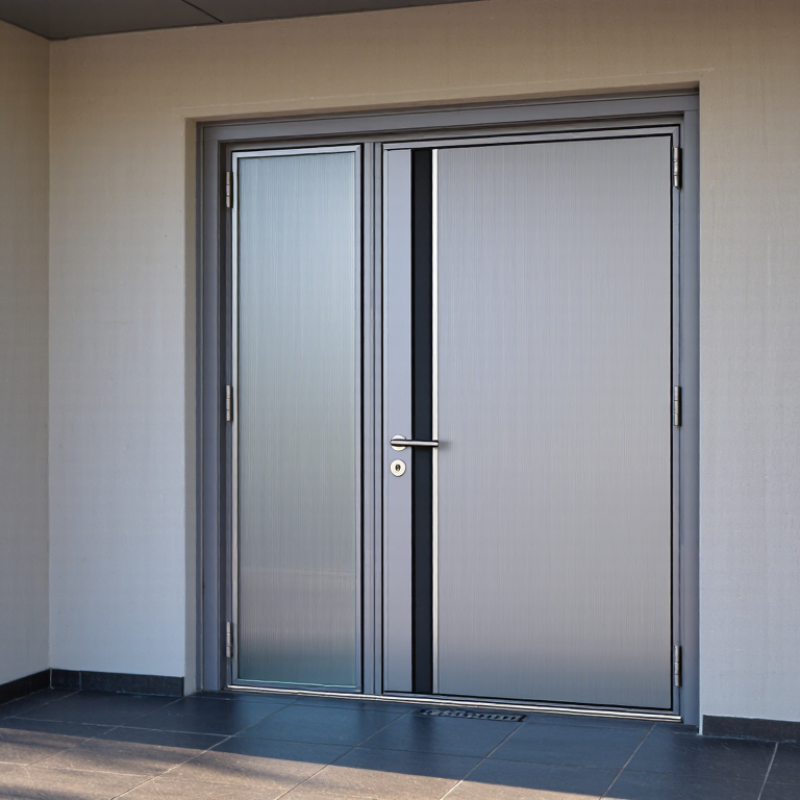
Who Is the Best Aluminium Entry Door Supplier in China?

China’s Aluminium Entry Door Market and Key Supplier Categories

Who Is the Best Aluminium Entry Door Supplier in China?

China’s Aluminium Entry Door Market and Key Supplier Categories

China’s aluminium entry door market includes specialist door manufacturers, broad building-material producers, and trading companies that coordinate production. Each category suits different project needs. Specialist factories often offer more control over profiles, finishes, hardware, and custom dimensions. Larger manufacturers may provide wider product ranges and established quality checks. Trading companies can simplify communication, but buyers should confirm who actually makes the door. The market is not uniform. Specifications and production standards vary.

A supplier’s category alone does not prove quality. Ask for section drawings, alloy and coating details, hardware specifications, and documented inspection procedures. For a real comparison, request a sample or review a completed project with similar exposure and dimensions. Check how the supplier handles packaging and replacement parts, too. These details matter when doors travel far or face frequent use. I would not judge performance from polished photos alone.

Tips: Compare like-for-like quotations, including frame depth, glazing, finish, lockset, and shipping protection. Request written tolerances and a clear lead time. A small mismatch in opening size can cause costly site adjustments. If an answer is vague, ask again. Manufacturers can make mistakes, and buyers can miss details; careful records help both sides catch them early.

How to Compare Suppliers Using GB/T 8478 and ISO 9001 Certification

When comparing aluminium entry door suppliers in China, start with GB/T 8478, the national standard for aluminium alloy doors and windows. Ask for the applicable edition and documents showing how the offered door was evaluated. A certificate alone may not describe your exact model, glass, frame depth, or hardware.

Check test reports carefully. Compare the tested configuration with your order: opening size, panel construction, seals, locks, and finish. Look for relevant performance results, such as air permeability, water tightness, and wind pressure resistance. A report for a similar-looking door is not enough. Ask who conducted the test and whether the report can be verified. Small differences matter.

ISO 9001 addresses a supplier’s quality management system, not the performance of one door. Review the certificate’s validity, issuing body, and scope. Does it cover the facility and activities involved in your order? Then ask how inspections are recorded, how defects are handled, and how production changes are controlled. Useful evidence includes inspection sheets, sample labels, and packaging records. A neat certificate is reassuring, but it cannot replace product-specific checks. I have seen buyers overlook this distinction; it is easy to do.

Thermal Performance: U-Values, Energy Ratings, and Insulated Door Cores

For a Chinese aluminium entry door supplier, thermal performance should be checked on the complete door, not inferred from the frame alone. The U-value measures heat transfer; a lower figure means less heat passes through the assembly. Ask for the tested whole-door U-value, including the frame, insulated core, seals, and any glazing. NFRC guidance explains that U-factor ratings help compare products, but ratings are meaningful only when the tested product matches the specification.

The core matters. A well-fitted insulated core, thermal breaks in the aluminium frame, and continuous perimeter seals can reduce heat loss and cold drafts near the threshold. The Passive House Institute’s cool-temperate component criteria set an exterior-door U-value limit of 0.80 W/(m²·K). That is a demanding reference, not a universal requirement. A lower laboratory value can still disappoint if installation leaves gaps. Ask suppliers for the test standard, report date, door dimensions, and whether the rating covers a glazed configuration. Small details matter. I would also check the threshold and corner joints in person; these are easy to overlook on a datasheet.

Who Is the Best Aluminium Entry Door Supplier in China? - Thermal Performance: U-Values, Energy Ratings, and Insulated Door Cores

Door Construction Typical Aluminium Frame Design Typical Insulated Core Core Thermal Conductivity
(W/m·K)
Typical Whole-Door U-Value
(W/m²·K)
Indicative Energy Performance Recommended Application
Basic aluminium door Non-thermally broken aluminium profiles Uninsulated aluminium sheet or lightweight panel Approximately 200 5.0–6.0 Low Interior doors, mild climates, and non-conditioned spaces
Standard thermal-break door Aluminium profiles with polyamide thermal barriers Polyurethane or polyisocyanurate foam core 0.020–0.028 1.6–2.2 Moderate to good Typical residential entrances in temperate climates
High-performance insulated door Deep multi-chamber thermal-break profiles with insulated threshold High-density PU/PIR foam or composite insulated panel 0.020–0.028 0.9–1.4 Good to very good Energy-efficient homes and cold or mixed climates
Premium low-U-value door Enhanced thermal-break frame, insulated threshold, and reduced metal bridging Thick PU/PIR core with insulated edge reinforcement 0.020–0.028 0.6–0.8 Very high; may support passive-house targets Low-energy and high-performance residential projects
Fire-resistant insulated door Thermally broken aluminium frame with tested fire-rated assembly Mineral wool or other tested fire-resistant core 0.035–0.045 1.4–2.5 Moderate to good, depending on design Buildings requiring fire, smoke, and thermal-performance testing
Supplier Evaluation Checklist
  • Request a whole-door U-value rather than a centre-panel value; the frame, glazing, threshold, hardware, and edge construction affect the final result.
  • Confirm that the declared U-value is supported by calculation or testing in accordance with relevant standards such as EN ISO 10077-1 or EN ISO 10077-2.
  • Check air-permeability, watertightness, wind-load, and thermal-cycling test results because lower U-values alone do not guarantee overall door performance.
  • Verify the thickness, density, and continuity of the insulated core, especially around locks, hinges, glazing rebates, and the threshold.
  • Energy-label categories are jurisdiction-specific; a door’s final rating can also depend on glazing, solar characteristics, air leakage, size, and installation quality.

Note: The performance figures are representative technical ranges for common aluminium entry-door constructions. Actual values must be confirmed for the complete door size, configuration, glazing, threshold, and installation method.

Testing Air, Water, and Wind Resistance Under EN 12207–12210 Standards

Who Is the Best Aluminium Entry Door Supplier in China?

A reliable aluminium entry door supplier should provide test evidence, not just confident claims. Ask for reports covering the complete door assembly, including its frame, seals, glazing, and hardware. A strong-looking panel means little if air slips through the corners. Small details matter.

EN 12207 classifies air permeability, while EN 12208 addresses watertightness and EN 12210 covers resistance to wind load. These tests examine different performance risks. During water testing, for example, technicians expose a mounted door to controlled spray and pressure, then check for water penetration. Wind testing assesses the door’s ability to withstand defined loads and limits on deflection. Ask for the report. Check that the tested dimensions and configuration match the door you plan to order.

A careful supplier can explain the test setup, classification, and limits without treating one result as a promise for every project. Installation quality, drainage, exposure, and maintenance also affect real-world performance. This distinction is easy to miss. I would compare documented results, construction details, and technical responses before choosing a supplier. Test data is useful, but it is not a substitute for checking how the door will be installed and used.

Supplier Selection: Customization, MOQ, Lead Time, Warranty, and Cost Metrics

For an aluminium entry door supplier in China, compare documented performance, not polished promises. Ask for customization drawings, finish samples, hardware specifications, and a written tolerance range. Then check whether the quoted MOQ applies to one design, one colour, or a mixed shipment. Small details matter. A low MOQ may still carry setup charges, while a long warranty means little without clear exclusions and a claims process. Request recent production and dispatch records; separate factory lead time from ocean transit and customs handling. The World Bank’s 2023 Logistics Performance Index assesses 139 economies across six dimensions, including timeliness. It is useful context for destination-side risk, but it cannot verify a supplier’s factory schedule.

Compare landed cost per finished door, including packaging, inspection, freight, and replacement-part terms. The International Aluminium Institute reports that recycling aluminium can use about 95% less energy than primary production. This makes recycled content worth asking about, but it does not prove strength or finish quality; request traceable material documentation. I would also compare warranty coverage by component, since frame, coating, seals, and hardware can fail differently. A neat spreadsheet can still hide vague specifications. That is an easy mistake to make. Ask for a sample inspection plan and measurable acceptance criteria before paying a deposit. If a supplier will not provide these, the cheapest quote may not be the lowest-risk choice.

Who Is the Best Aluminium Entry Door Supplier in China?

Compare suppliers using buyer-defined priorities for customization, MOQ flexibility, lead time, warranty and cost.

Example evaluation weights, totaling 100%. These are a practical starting point—not market survey results. Adjust them to fit your project, and verify each supplier’s specifications, production schedule, warranty terms and quotation.

FAQS

Why should I check the whole door’s U-value?

Heat transfer depends on the frame, insulated core, seals, threshold, and glazing. A lower U-value usually means better insulation. Frame data alone can mislead.

What details should appear in a thermal test report?

Check the tested door dimensions, configuration, report date, and test method. Confirm whether glazing was included. The tested model must match your order.

How does an insulated aluminium door reduce cold drafts?

Thermal breaks interrupt heat flow through the aluminium frame. A fitted core and continuous perimeter seals reduce air movement. Inspect the threshold and corner joints carefully.

Is a very low laboratory U-value always reliable?

No. Installation gaps can weaken excellent laboratory results. Poor drainage or damaged seals may also affect performance. Real buildings are less tidy.

What do air, water, and wind tests measure?

Air testing measures leakage through the assembly. Water testing checks resistance to controlled spray and pressure. Wind testing examines load resistance and frame deflection.

How can I compare a supplier’s test evidence?

Request reports for the complete door, including seals, hardware, glazing, and frame. Compare tested dimensions with your planned door. One result cannot promise everything.

Which commercial details deserve careful checking?

Review customization drawings, finish samples, hardware specifications, MOQ, lead time, and warranty exclusions. Separate factory production time from shipping and customs handling. Written details matter.

How should I compare the real cost of different suppliers?

Calculate the landed cost per finished door. Include packaging, inspection, freight, replacement parts, and possible setup charges. The cheapest quote may hide risk.

Should I ask about recycled aluminium content?

Yes, but request traceable material documentation. Recycled aluminium can reduce production energy, but it does not prove strength or finish quality. Do not assume too much.

What should happen before paying a deposit?

Ask for a sample inspection plan and measurable acceptance criteria. Clarify warranty coverage for frames, coatings, seals, and hardware. Vague promises deserve another look.

Conclusion

Choosing the best Aluminium Entry Door supplier in China requires comparing more than price. Buyers should assess a supplier’s experience, production capabilities, customization options, minimum order quantity, lead time, warranty terms, and overall cost. GB/T 8478 compliance and a documented ISO 9001 quality management system can help indicate whether products and manufacturing processes meet relevant requirements, but certifications should be verified and considered alongside product-specific evidence.

Performance is equally important. Compare U-values, energy ratings, and insulated door-core options to understand thermal efficiency, then review test data for air permeability, water tightness, and wind resistance against the applicable EN 12207–12210 standards. A clear, like-for-like comparison of specifications, testing, service, and delivery terms can help buyers identify a supplier suited to their project’s climate, design, and budget.

Eleanor

Eleanor

Eleanor is a dedicated marketing professional with a strong understanding of the company’s products, services, and customer needs. With a background in market research, content strategy, and business communication, she transforms complex product information into clear, practical, and engaging......