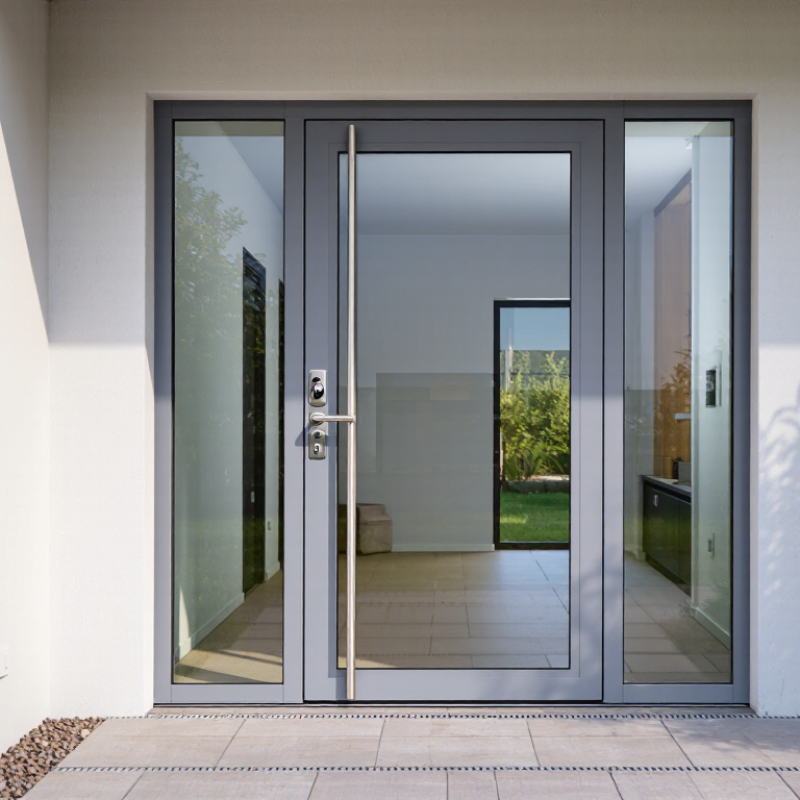
A Modern Aluminum Entry Door combines clean design, structural strength, and carefully engineered performance. Its frame usually uses aluminum profiles, insulated panels, durable glazing, and secure multi-point hardware. Unlike older metal doors, current systems may include thermal breaks that reduce heat transfer through the frame. That detail matters near a cold hallway or a sunlit entrance.
In practice, door quality depends on more than appearance. Experienced installers examine the wall opening, threshold height, drainage path, and hinge alignment before installation. A precisely fitted door should open smoothly without scraping. It should also close firmly, while weather seals remain evenly compressed. Powder-coated finishes can resist fading and surface wear, but exposure, maintenance, and coating quality still affect long-term results. Small details matter.
Design is only one part of the decision. Homeowners should compare U-values, air leakage ratings, glass specifications, warranty terms, and hardware certifications. Regional climate also matters. A large glass panel may brighten a dark foyer, yet it can increase solar heat near a south-facing entrance. The best choice balances daylight, insulation, security, and daily comfort.
The label can mislead.
Not every slim aluminum door performs equally well. Some attractive models have weak seals, poor thresholds, or limited adjustment options. This is where professional guidance becomes valuable. A qualified supplier can explain test data and installation requirements without relying on vague marketing claims. Careful measurement remains essential. Even an excellent door can perform poorly when installed carelessly. This guide examines what defines a Modern Aluminum Entry Door and how to judge its real value beyond photographs.
What Is a Modern Aluminum Entry Door?
A modern aluminum entry door is a complete entrance system, not merely a metal slab. It usually combines a thermally broken aluminum frame, an insulated door panel, weather seals, and optional low-emissivity glazing. The frame may look narrow and clean, yet its internal polyamide barrier reduces heat transfer between indoor and outdoor surfaces. This detail matters during cold mornings and intense summer afternoons.
Performance should be measured, not assumed. The U.S. Department of Energy reports that windows can represent 25–30% of residential heating and cooling energy use. A glazed aluminum entry door belongs to this same performance conversation. The International Energy Agency also reports that buildings consume about 30% of global final energy. Therefore, modern design should include tested air leakage, water resistance, structural strength, and thermal performance. A beautiful door is not automatically efficient.
In daily use, quality appears through small details: a handle that closes smoothly, seals that remain flexible, and a threshold that blocks wind-driven rain. Industry testing under AAMA/WDMA/CSA 101/I.S.2/A440 standards helps verify these functions. However, installation remains a weak point. Even a well-engineered door may leak around an uneven opening or poorly sealed sill. That is easy to overlook. Aluminum is durable and recyclable, but its production also carries embodied energy. Specifiers should examine recycled content, local climate, glazing area, and long-term maintenance before choosing a design.
A modern aluminum entry door begins with a balance between appearance, strength, and thermal control. Designers usually select narrow profiles to create more glass and cleaner sightlines. However, slim framing alone does not guarantee performance. The frame needs a thermal break, often made from reinforced polyamide, to reduce heat transfer between interior and exterior surfaces. According to the U.S. Department of Energy, windows can account for 25–30% of residential heating and cooling energy use. Entry doors deserve similar attention.
Manufacturing starts with precision extrusion and CNC cutting. Technicians check profile dimensions before assembling the frame. Corner joints may be mechanically crimped, screwed, or reinforced with internal blocks. Gaskets must sit evenly around the panel. Small gaps can cause drafts, rattling, or water penetration. Insulated glass, multi-point locks, adjustable hinges, and compression seals are then installed according to the project’s climate and security requirements. Testing commonly evaluates air leakage, water resistance, structural pressure, and thermal values under recognized performance standards.
The finish also affects durability. Powder coating creates a consistent surface and can reduce routine maintenance. The International Aluminium Institute reports that recycling aluminum may save up to 95% of the energy required for primary production. That figure makes material selection worth examining, not merely decorating. In my experience, installation quality remains the weak point. Even an accurately manufactured door can perform poorly with an uneven threshold or compressed seal. Perfect results are uncommon. Careful inspection still matters.
What Is a Modern Aluminum Entry Door?
Security, Insulation, and Weather Resistance Features
A modern aluminum entry door combines a strong frame with carefully engineered comfort features. Its aluminum shell resists warping, rust, and daily impacts. A multi-point locking system secures the door at several points. Reinforced hinges also reduce forced movement. I have found that solid installation matters as much as the lock itself.
Insulation begins inside the frame. Thermal breaks separate the exterior aluminum from the interior surface. This reduces heat transfer during hot summers and cold winters. Insulated panels and low-emissivity glass can improve indoor comfort. Quality seals around the edges stop drafts, dust, and outside noise. Small gaps can undermine expensive materials.
Weather resistance needs practical details. Compression gaskets should press evenly when the door closes. A sloped threshold helps guide rainwater away. Drainage channels prevent water from collecting near the sill. Powder-coated finishes can protect exposed surfaces, but they still need cleaning. No door is completely maintenance-free.
I once focused too much on appearance. That was a mistake. A beautiful door can still leak air or water if the frame is poorly aligned. Professional measurement, correct flashing, and careful adjustment deserve equal attention. Local climate also changes the best specification. Coastal air, heavy rain, and strong sunlight each create different demands. Testing the latch, seals, and threshold after installation remains a useful habit.
A modern aluminum entry door is more than a metal slab. Its style begins with proportion, sightlines, and the relationship between glass and frame. In practice, homeowners often choose pivot, single, or double-door configurations. A narrow sidelight can brighten a dark hallway. It can also reduce privacy, which is easy to overlook. Flush panels suit minimalist homes, while framed glass panels add a softer, transitional character.
Configuration affects daily performance. Insulated cores, thermal breaks, multi-point locks, and compression seals help limit drafts around the opening. The U.S. Department of Energy reports that windows account for roughly 25–30% of residential heating and cooling energy use. A large glazed entry system should therefore receive similar attention. Low-emissivity glass, appropriate solar heat-gain control, and carefully sized glazing can improve comfort. Yet more glass is not automatically better.
Customization should be practical, not decorative for its own sake. Common choices include powder-coated colors, wood-look finishes, satin or textured glass, concealed closers, and custom heights. The National Fenestration Rating Council evaluates products through metrics such as U-factor and solar heat-gain coefficient, giving buyers a clearer comparison method. Local climate still matters. A dark finish may absorb intense sunlight, while west-facing glass can create afternoon glare. I have seen elegant oversized doors perform poorly when installers ignored drainage and threshold height. That detail deserves more attention. The best specification balances appearance, security, maintenance, daylight, and actual weather exposure.
| Dimension | Common Options | Typical Specifications or Characteristics | Customization and Planning Notes |
|---|---|---|---|
| Basic Construction | Extruded aluminum frame with an insulated or non-insulated door panel | Aluminum is lightweight, corrosion-resistant, dimensionally stable, and does not require routine repainting to prevent rust. | Select a thermally broken frame for conditioned spaces and cold or mixed climates. |
| Door Styles | Flush slab, minimalist framed, glass-panel, slatted, louvered, and architectural panel designs | Smooth surfaces create a contemporary appearance, while applied panels, grooves, and vertical lines add visual depth. | The exterior pattern can be coordinated with the building facade, garage door, windows, or balcony railings. |
| Operating Configurations | Single door, single door with sidelite, double door, and door with transom | Single doors suit most residential entrances; sidelites and transoms increase daylight and perceived entry width. | Confirm rough-opening dimensions, handing, swing direction, clearance, and local egress requirements before ordering. |
| Typical Door Sizes | Common nominal widths include 30, 32, 36, and 42 inches; common heights include 80 and 96 inches | Actual frame and rough-opening dimensions vary by system, threshold, jamb design, and installation method. | Oversized or pivot-style entrances require structural review, adequate wall support, and properly sized hardware. |
| Thermal Performance | Non-thermal frame, thermally broken frame, insulated panel, and insulated glass | A thermal break separates interior and exterior aluminum members to reduce conductive heat transfer and interior condensation risk. | Look for tested U-factor and air-infiltration results for the complete door assembly rather than the frame alone. |
| Panel Insulation | Insulated aluminum sandwich panel with a foam or mineral-based core | Insulated panels generally provide better heat flow resistance and sound control than hollow panels. | The overall result depends on panel thickness, edge construction, weather seals, threshold, and installation quality. |
| Glazing | Clear, frosted, tinted, textured, laminated, tempered, double-pane, and triple-pane glass | Tempered glass is designed to break into smaller granules; laminated glass remains bonded to an interlayer after breakage. | Choose glazing based on privacy, daylight, impact-safety requirements, solar exposure, and local building regulations. |
| Glass Layout | Full-height glass, narrow vertical lite, horizontal lite, top lite, or geometric grid | Larger glazed areas increase natural light but may reduce privacy and can increase solar heat gain if not specified appropriately. | Use low-emissivity glazing or solar-control glass where energy performance and strong sunlight are concerns. |
| Surface Finish | Powder coating, anodized finish, metallic finish, matte finish, and wood-look finish | Powder coating creates a durable colored finish; anodizing forms a protective oxide layer and commonly produces metallic tones. | Specify exterior and interior colors separately when the door system supports dual-color finishing. Confirm color-matching tolerances. |
| Color Selection | Black, white, gray, bronze, silver, natural metallic tones, and custom architectural colors | Dark finishes can absorb more solar heat, especially on sun-exposed elevations. | For exposed locations, confirm the finish warranty, cleaning instructions, and suitability for the local climate. |
| Hardware | Lever handles, pull handles, multipoint locks, deadbolts, concealed closers, and electronic locks | Multipoint systems engage the door at several locations and can improve compression of weather seals when correctly adjusted. | Verify lock backset, cylinder format, handle height, handing, power requirements, and compatibility with home-access systems. |
| Threshold and Weather Sealing | Adjustable threshold, low-profile threshold, compression gaskets, bulb seals, and sweep seals | A continuous weather-seal system helps limit air leakage and water penetration at the perimeter and bottom of the door. | Threshold height must balance water management, accessibility, floor transitions, and local code requirements. |
| Security Features | Reinforced lock zones, multipoint locking, laminated glass, concealed fasteners, and anti-lift hardware | Security performance depends on the complete assembly, including frame anchoring, lock hardware, hinges, glass, and installation. | For high-security locations, request independently tested performance data and professional installation. |
| Accessibility | Low threshold, lever handle, power-assisted operator, and clear opening sized for wheelchair access | Accessibility requirements may address clear width, opening force, threshold height, maneuvering space, and hardware operation. | Check the applicable local accessibility standard because requirements vary by building type and jurisdiction. |
| Weather and Corrosion Resistance | Marine-grade finish systems, sealed joints, drainage paths, and stainless-steel hardware | Aluminum naturally forms a protective oxide layer, but dissimilar-metal contact, salt exposure, and trapped moisture still require attention. | Near coastal areas, specify suitable coatings, isolate incompatible metals, and follow the manufacturer’s cleaning schedule. |
| Sound Control | Insulated panel, laminated glass, compression seals, and heavier-duty perimeter gaskets | Sound reduction is influenced by the weakest component, often the glass, perimeter seals, threshold, or surrounding wall. | Request a tested sound-transmission rating for the complete door assembly when traffic or urban noise is a concern. |
| Maintenance | Routine washing, seal inspection, hardware lubrication, and finish cleaning | Aluminum doors generally need less maintenance than painted steel or wood doors, but seals, drainage paths, and moving hardware still require inspection. | Use mild soap and water unless the finish-care instructions specify otherwise; avoid abrasive cleaners and harsh solvents. |
| Performance Testing | Air leakage, water penetration, structural load, thermal transmittance, and forced-entry testing | Test results apply to a defined size, configuration, glazing type, and installation condition. | Compare complete-assembly ratings and confirm that the selected configuration matches the tested product size and options. |
| Note: Dimensions, thermal values, finish durability, and performance ratings vary by door design, glazing, hardware, climate, and installation. Always verify project-specific requirements against applicable local building and accessibility codes. | |||
A modern aluminum entry door needs careful installation, not just attractive hardware. The opening must be square, dry, and strong enough to carry the frame. An experienced installer checks the rough opening, sets durable shims, and fastens the frame without twisting it. Flashing around the sill and jambs directs rainwater away from the wall. The threshold should meet the finished floor evenly. Small errors matter.
Maintenance is simple but should not be ignored. Wipe the frame with mild soap and water several times each year, especially in coastal areas. Avoid abrasive pads that can damage the protective finish. Check hinges, locks, weatherstripping, and drainage openings during seasonal inspections. Tighten loose screws carefully, and replace flattened seals when drafts or water appear. I have seen neglected seals cause more comfort problems than the door panel itself.
With correct installation and ordinary care, an aluminum entry door often serves for 25 to 40 years. Service life depends on climate, coating quality, usage, and drainage around the entrance. Harsh coastal air, standing water, and repeated impact can shorten that period. A professional inspection can reveal frame movement, corrosion near fasteners, or failing seals before repairs become expensive. I sometimes find minor alignment issues left too long. They are easy to prevent, but rarely fix themselves.
It is a complete entrance system, not just a metal slab.
A polyamide barrier separates indoor and outdoor aluminum surfaces.
No. Appearance can mislead.
The opening should be square, dry, and strong.
Flashing around the sill and jambs directs rain away from the wall.
Wash the frame with mild soap and water several times yearly.
Check hinges, locks, weatherstripping, screws, and drainage openings.
With proper installation and ordinary care, it may serve for 25 to 40 years.
An inspection may reveal frame movement, fastener corrosion, or failing seals.
A Modern Aluminum Entry Door combines clean architectural design, durable construction, and practical performance for contemporary homes and commercial spaces. Built from lightweight yet strong aluminum, it is engineered through precise forming, cutting, finishing, and assembly processes to create a stable door system with smooth operation and long-term reliability. Its design may include large glass panels, minimalist frames, concealed hardware, and customized colors or surface textures.
Beyond appearance, a Modern Aluminum Entry Door can provide strong security through reinforced frames, multipoint locking systems, and impact-resistant components. Thermal breaks, insulated cores, and quality seals help improve energy efficiency, while weather-resistant finishes protect against moisture, sunlight, and temperature changes. Available in hinged, pivot, sliding, single, or double-door configurations, these doors can be tailored to different openings and architectural styles. Professional installation ensures proper alignment and sealing, while routine cleaning, hardware checks, and occasional adjustments help maintain performance. With suitable care, a quality aluminum entry door can deliver dependable service for many years.