CE Certified Architectural Entry Doors & Custom Exterior Systems
Explore our flagship factory-direct exterior front doors engineered for modern residential estates, coastal villas, and high-security commercial developments across Europe, North America, and Australia.
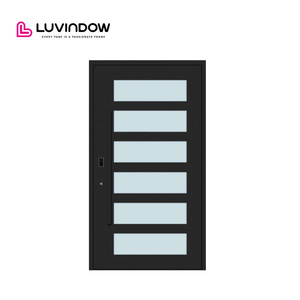
Secure Large Opening Aluminum Entry Pivot Doors For High End North American Residential Communities
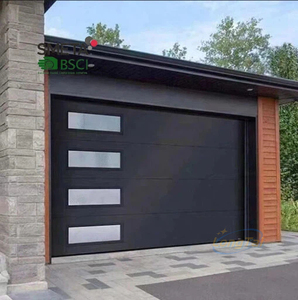
Andexin Coastal Weather Proof Aluminum Alloy Garage Entry Door
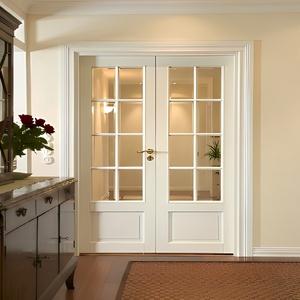
PDP Hurricane Impact Aluminum Alloy Waterproof Minimalist Exterior & Interior Casement French Doors High-Transparency Screen
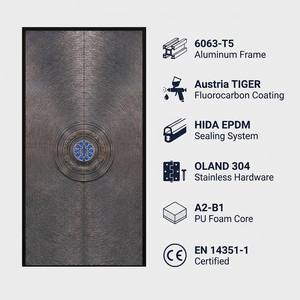
Salt Spray Resistant Aluminum Beach House Door Coastal Villa Tropical Australia Designer Quality
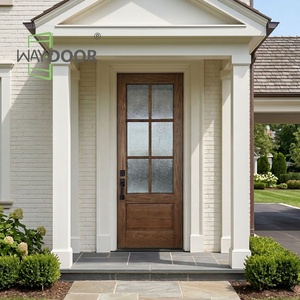
Fully Customized Soundproof Single Front Solid Wood Door With 6 Glass Panels For Houses Room Mahogany Oak Wooden Exterior Door
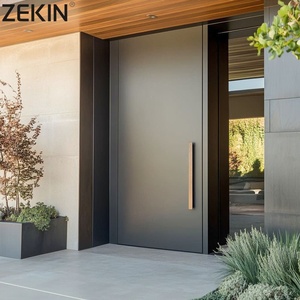
ZEKIN Outdoor Back Painted Glass Anti-theft Exterior Security Aluminum Cast Pivot Door Sound Insulation Front Entry Main Doors
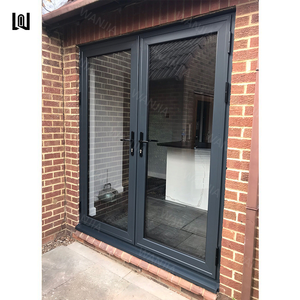
WANJIA Factory Customized Front Entry Aluminum French Doors Exterior French Front Entry Glass Doors Patio Glass Casement Door
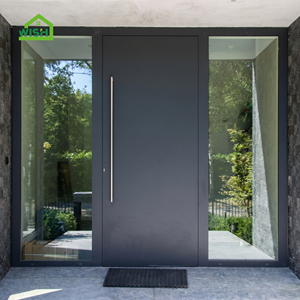
Modern Style Heavy Duty Manual Pivot Entry Door Finished Surface Exterior Aluminum Door Featuring Sound Waterproof Thermal
CE Certified Front Door Sourcing Blueprint: Decoding EN 14351-1 Technical Standards
In the global architectural hardware and building facade industry, securing verified CE Certified Front Door Supplier credentials is far more than a legal prerequisite for entering the European Economic Area (EEA)—it is the fundamental benchmark for structural reliability, occupant safety, and thermal performance. The European Harmonized Standard EN 14351-1:2006+A2:2016 specifies performance characteristics for external pedestrian door sets without fire resistance and/or smoke leakage characteristics.
When commercial procurement managers, real estate developers, and international facade contractors audit custom front door factories in China, understanding the precise engineering requirements behind the CE mark is essential to preventing project delays, custom clearance rejections, and post-installation thermal failure.
Critical Sourcing Knowledge: Genuine CE certification under EN 14351-1 requires mandatory Initial Type Testing (ITT) conducted by a European Union Notified Body (NB), alongside a audited Factory Production Control (FPC) system under System 3 or System 1 attestation of conformity.
1. Thermal Transmittance ($U_d$ Value) & Energy Efficiency Compliance
Under European building energy codes (such as Germany's GEG and the UK Building Regulations Part L), external entry doors must achieve demanding overall thermal transmittance thresholds ($U_d \le 1.2\text{ W}/(\text{m}^2\cdot\text{K})$ for residential, and down to $U_d \le 0.8\text{ W}/(\text{m}^2\cdot\text{K})$ for Passive House standards). Leading CE certified front door factories achieve these values by integrating multi-chambered polyamide thermal break profiles (PA66 GF25), warm-edge spacers, and triple-glazed Low-E insulated glass units (IGU) filled with 90% Argon gas.
2. Air Permeability, Watertightness, and Wind Load Ratings
Front entry doors serve as the primary envelope threshold between extreme external weather and conditioned indoor living space. CE certified systems undergo rigorous mechanical testing according to EN standards:
- Air Permeability (EN 12207): Classified from Class 1 up to Class 4 (maximum air tightness under positive pressure up to 600 Pa). High-end aluminum entry doors utilize continuous EPDM rubber seals and drop-down acoustic automatic bottom gaskets to stop air infiltration.
- Watertightness (EN 12208): Tested under static water spray up to Class 9A or Class E1050 (unexposed water resistance under severe storm pressures exceeding 1050 Pa).
- Resistance to Wind Load (EN 12210): Rated from Class A1 to Class C5. A Class C5 rating ensures structural deflection does not exceed 1/300 of the span under high wind loads up to 2000 Pa, with safety pressure testing up to 3000 Pa.
Future Procurement & Technological Trends in Architectural Front Doors (2026–2035)
As global architectural designs shift toward minimalist aesthetics, smart automation, and ultra-low carbon footprints, front entry door manufacturing is undergoing a structural technological evolution.
1. Low-Carbon Aluminum & EPD Transparency
Global developers are demanding Environmental Product Declarations (EPDs) certified under EN 15804. Leading Chinese suppliers are adopting low-carbon primary aluminum smelted via hydropower alongside high-grade post-consumer recycled alloys to lower embodied carbon footprint by up to 65%.
2. Mechatronic Smart Access & Biometric Integration
Traditional mechanical key cylinders are rapidly giving way to motorized multi-point locking mechanisms integrated with facial recognition, 3D biometric fingerprint scanners, RFID keys, and smart home protocols (Zigbee 3.0, Matter, KNX) backed by emergency battery overrides.
3. Oversized Ultra-Heavy-Duty Pivot Architecture
Modern architectural luxury trends favor massive grand entry openings up to 2.5 meters wide and 4.0 meters high. Manufacturing these sizes requires floor-recessed hydraulic offset pivot hinges capable of supporting sash weights exceeding 500 kg while maintaining effort-free operation.
4. Cross-Regional Multi-Certification Engineering
Tier-1 suppliers are consolidating compliance pathways by developing platform door systems that concurrently hold European CE marks, Australian AS2047 standard certificates, North American NFRC ratings, and Florida High-Velocity Hurricane Zone (HVHZ) impact approvals.
Technical Comparison Matrix: CE Certified Entry Door Configurations
To assist architectural buyers in matching door specifications with project zoning requirements, the matrix below outlines performance parameters across our primary entry door profile configurations:
| System Type | Profile Depth & Alloy | Thermal $U_d$ Value | Air tightness (EN 12207) | Water tight (EN 12208) | Burglar Rating (EN 1627) |
|---|---|---|---|---|---|
| Thermal Break Hinged Door | 75mm 6063-T6 (2.0mm Wall) | 1.1 – 1.3 $\text{W}/(\text{m}^2\cdot\text{K})$ | Class 4 (600 Pa) | Class E900 (900 Pa) | RC2 / RC3 Compliance |
| Architectural Heavy Pivot Door | 100mm Thermal Break Aluminum | 0.9 – 1.2 $\text{W}/(\text{m}^2\cdot\text{K})$ | Class 4 (600 Pa) | Class E1050 (1050 Pa) | RC3 High Security |
| Hurricane Coastal Impact Door | 90mm Reinforced Aluminum | 1.3 – 1.5 $\text{W}/(\text{m}^2\cdot\text{K})$ | Class 4 (600 Pa) | Class E1200 (1200 Pa) | RC4 / Impact Tested |
| Back Painted Glass Cast Pivot | 105mm Cast Profile + Tempered Glass | 1.0 – 1.2 $\text{W}/(\text{m}^2\cdot\text{K})$ | Class 4 (600 Pa) | Class E900 (900 Pa) | RC3 Anti-Theft Rating |
Why Partner with Foshan Aluvoy Entry Door Systems Co., Ltd.?
Founded in 2005, Foshan Aluvoy Entry Door Systems Co., Ltd. has established itself as an industry-leading manufacturer and exporter of premium CE certified front doors, high-performance aluminum windows, curtain wall systems, and architectural entrance solutions in Foshan, Guangdong—China's global capital for aluminum fabrication.
Spanning a modern 20,000 square meter factory base staffed by over 150 highly trained engineers and production technicians, our facility operates two automated high-precision production lines integrated with imported German CNC machining centers, automatic corner crimping units, and dual-component structural silicone injection robots.
Authentic Multi-National Certifications
Our products are fully verified by authentic certifications: European CE Mark (EN 14351-1), Australian AS2047 (issued via SAI Global), North American NFRC thermal standards, and Florida Building Code Hurricane Product Approvals for coastal regions.
In-House Milling & Rigorous QC
Unlike trading agencies that outsource production, every process—profile extrusion cutting, CNC lock slotting, corner injection, gasket fitting, and preliminary air/water chamber testing—is performed inside our own factory workshop under strict ISO9001 supervision.
10,000+ Containers Shipped Worldwide
Since 2005, over 1,000 international builders, architectural firms, and window dealers from 30+ countries have visited our Foshan manufacturing facility. We have successfully delivered over 10,000 container shipments backed by customized export crating.
Frequently Asked Questions for CE Certified Front Door Sourcing
Clear technical answers to help architects, real estate developers, and window importers navigate factory selection, certification validation, and custom manufacturing workflows.
How can I verify if a front door supplier's CE certification is authentic?
Authentic CE certification under EN 14351-1 must be issued by a accredited European Union Notified Body (NB). Request the supplier's Declaration of Performance (DoP), the official Initial Type Testing (ITT) laboratory report, and the Notified Body's registration number. You can verify the Notified Body's legitimacy on the European Commission's NANDO (Single Market Compliance System) database. Foshan Aluvoy provides full, unredacted laboratory test documentation for client verification prior to contract signing.
What is the difference between CE certification and European standard compliance?
"Compliance" often means a manufacturer self-claims their product follows European norms without independent lab testing. "CE Certification" under EN 14351-1 requires mandatory third-party laboratory testing by a Notified Body covering thermal insulation ($U_d$), air infiltration (EN 12207), water tightness (EN 12208), and wind resistance (EN 12210), backed by continuous Factory Production Control (FPC) audits.
Can Aluvoy manufacture front entry doors to custom project drawings and structural specs?
Yes. Every entry door order is fabricated strictly to your architectural elevations, structural wall opening schedules, and custom glazing specifications. Our dedicated technical engineering department translates architectural CAD/BIM drawings into comprehensive shop drawings for client review, dimensional sign-off, and hardware approval before raw material cutting begins.
What structural warranties are provided with CE certified aluminum front doors?
Foshan Aluvoy Entry Door Systems Co., Ltd. provides a comprehensive 10-year structural frame and surface finish warranty. Surface treatments utilizing Qualicoat Class 2 powder coatings or marine-grade anodizing are warrantied against fading, chalking, peeling, and coastal salt-spray corrosion under normal maintenance conditions.
How do thermal breaks in aluminum front doors improve energy ratings?
Aluminum is naturally highly conductive. To prevent heat transfer, a thermal break profile splits the outer and inner aluminum profile sections using low-conductive polyamide glass-fiber reinforced struts (PA66 GF25). This barrier blocks thermal bridging, drastically lowering thermal transmittance ($U_d$ value) and eliminating interior frame condensation in freezing winters.
What hardware options and security locking mechanisms are available?
We integrate premier European multi-point locking systems (such as German Siegenia, GU, or Hoppe) achieving European Burglar Resistance Ratings up to RC2 and RC3 (EN 1627). Options include motorized automatic multi-point locks, hidden heavy-duty 3D adjustable hinges, offset pivot hinges, keypads, and biometric smart access systems.
What glass configurations are available for CE certified front doors with light panels?
We supply tempered safety glass, laminated safety glass (EN 14449 / BS EN 12600), and specialized acoustic or hurricane impact glazing setups. Double or triple-glazed units utilize argon gas fill, low-emissivity (Low-E) coatings, and warm-edge Swisspacer channels to optimize thermal efficiency and sound attenuation up to 45 dB.
How does the factory ensure export packing protects products during ocean shipping?
With experience shipping over 10,000 containers worldwide, our export packaging protocol involves a 5-layer protective wrapping sequence: full-cover protective film on finished surfaces, thick corner plastic protectors, shock-absorbing EPE foam wrapping, moisture-barrier shrink wrap, and fully enclosed fumigated plywood wooden crates to prevent sea-freight moisture and impact damage.
What is the standard lead time for custom front door production and export delivery?
Our standard factory manufacturing timeline is typically 25 to 35 days following shop drawing sign-off and color sample approval. Ocean freight transit times vary depending on destination ports: approximately 15-22 days to Australia/New Zealand, 20-30 days to West/East coasts of North America, and 28-35 days to main European ports.
Can overseas buyers visit the factory to conduct pre-shipment quality audits?
We welcome international buyers, developers, and third-party inspection agencies (such as SGS, Bureau Veritas, or TÜV) to audit our production lines in Foshan, China. For remote clients, we provide full video inspection logs, dimensional check reports, and operation test videos before container sealing.
Ready to Source CE Certified Entry Doors Direct from the Factory?
Contact our technical export team today to submit your project drawings, request certified laboratory test reports, or schedule an engineering consultation for your upcoming residential or commercial development.