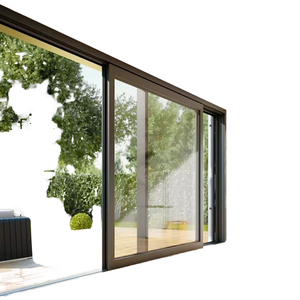
CE Certified High Performance Aluminum Door Factories & Supplier
Technical Whitepaper & Global B2B Sourcing Guide for Architectural Engineering, Commercial Developers, and High-End Residential Fenestration Systems
Flagship Engineering Systems
CE Certified High Performance Aluminum Doors
Precision-engineered aluminum entrance, folding, hurricane-impact, and automated industrial door systems certified to European (CE EN 14351-1), Australian (AS2047), and North American (NFRC/Florida NOA) standards.
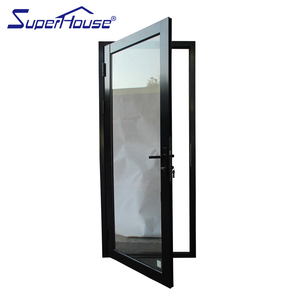
Aluminum Outdoor Door for Interior Designers & Renovation Companies
Architectural-grade exterior aluminum hinged doors featuring micro-slim frames, concealed heavy-duty hinges, and weather-seal gaskets engineered for contemporary residential renovations.
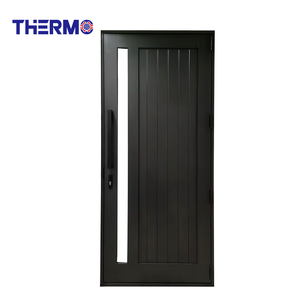
Therm Modern Exterior Vertical Glass Insert and Wood Grain Finish Aluminum Entrance Door
Thermally broken polyamide profile paired with high-durability heat-transfer wood grain powder coating and argon-filled low-E vertical vision glass inserts for luxury entrance statements.
Miami NOA Approved Modern Hurricane Proof Impact Resistance Triple Glazed Aluminum Alloy Hinged Patio Door
Heavy-duty structural aluminum frame with SGP laminated impact-resistant glass, engineered to withstand Category 5 hurricane pressures and missile impact tests (TAS 201/202/203).
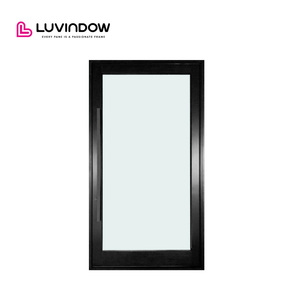
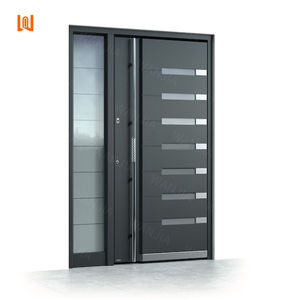
High Performance Thermal Insulation Wide Access Aluminum Pivot Entry Doors for Luxury Builder Residential Projects
Oversized architectural pivot system featuring custom hydraulic floor springs, German multipoint locking security, and PA66 nylon thermal barrier insulation achieving low U-factors.
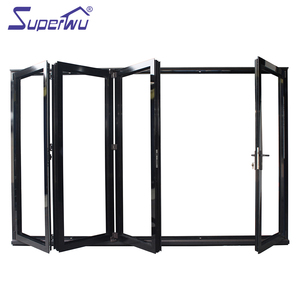
Superwu Australian Standard AS2047 AS/NZS2208 AS1288 Aluminum Exterior Glass Folding Door
Certified by SAI Global for Australian climate compliance. Seamless top-hung rolling hardware with heavy-wall extrusion profiles designed for large-span multi-panel bi-fold installations.
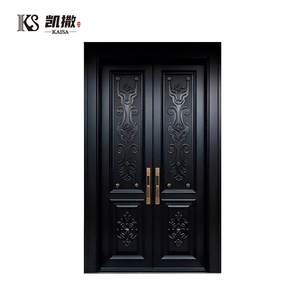
High Performance Large Aluminium Entrance Door, Waterproof, Fireproof and Cold Resistant European Style
European-inspired thermal entrance system constructed with multi-chamber profiles, EPDM weather-stripping, and high-security anti-burglary hardware class RC2/RC3.
Stylish Residential Aluminum Frame Double Glazed Stormproof Entry Door
Engineered for extreme coastal wind-driven rain environments. Reinforced frame corner joints, integrated drainage sub-sills, and double toughened low-E insulating glass.
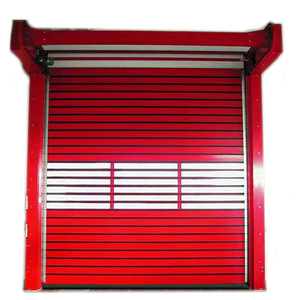
High Quality Remote Control Electric Automatic Aluminum Fast Hard Turbo Doors for Warehouse
High-speed spiral aluminum turbo door system for industrial logistics facilities. Features automated radar sensors, servo control motor, high thermal insulation slats, and wind resistance up to Class 12.
Foshan Aluvoy Entry Door Systems Co., Ltd., founded in 2005, operates as a premier manufacturer and global exporter of certified aluminum window and door systems, architectural curtain walls, and specialized entrance solutions. Operating out of a modern 20,000 square meter production complex equipped with dual automated assembly lines, our team of over 150 skilled engineers, metallurgists, and technical specialists delivers tailored fenestration products to over 30 countries across North America, Europe, Australia, and the Middle East.
To deliver measurable performance gains over conventional architectural metal fabricators, Aluvoy enforces rigorous quality-assurance frameworks at every phase of production. We maintain complete in-house fabrication control—ranging from high-precision aluminum profile cutting, CNC milling, and mechanical corner-crimping to silicone structural sealant glazing and multi-stage quality control checks.
European CE (EN 14351-1) Certified
Fully compliant with EU Regulation (EU) No 305/2011. Tested under EN 12207 (Air Permeability Class 4), EN 12208 (Watertightness Class E1050), and EN 12210 (Wind Resistance Class C5).
Australian AS2047 & AS2208 Accredited
Verified through SAI Global audits. Certified for structural deflection, air infiltration, and high water-penetration resistance under Australia’s demanding National Construction Code (NCC).
North American NFRC & Florida HVHZ NOA
Tested according to NFRC 100/200/400 standards for thermal transmittance and solar heat gain coefficient (SHGC), alongside Florida High Velocity Hurricane Zone (HVHZ) impact certification.
Information Gain Benchmark: Unlike conventional trading entities or regional fabricators who outsource assembly, Aluvoy executes 100% of profile milling, thermal break crimping, corner joining, and unitized glazing in-house under ISO 9001 certified procedures. Every door assembly comes backed by an extended 10-Year Comprehensive Factory Warranty.
Technology Evolution
Product Development & Architectural Technology Trends in Aluminum Doors
The architectural door industry is experiencing a monumental transformation driven by stringent global energy conservation codes, urban sound attenuation demands, and evolving aesthetic preferences for ultra-slim profile sightlines. Commercial developers and residential architects no longer evaluate aluminum doors solely as structural barrier elements; they are now analyzed as active thermal envelopes, acoustic barriers, and smart building interfaces.
Traditional non-thermal aluminum doors suffer from high thermal conductivity ($K \approx 160 \text{ W/m}\cdot\text{K}$), leading to high energy losses and condensation risks. Modern high-performance doors incorporate advanced thermal breaks constructed from 24mm to 34mm multi-cavity Polyamide 66 reinforced with 25% glass fiber (PA66 GF25). This lowers frame thermal transmittance ($U_f$) down to $\le 1.1 \text{ W/m}^2\text{K}$. Furthermore, modern designs integrate warm-edge composite spacers (such as Technoform or TGI) combined with low-emissivity (Low-E) triple glazing filled with 90%+ pure argon gas, reducing total door system U-factors below $0.85 \text{ W/m}^2\text{K}$ to meet Passive House criteria.
2. Surface Finishing Innovations: PVDF Fluorocarbon vs. Architectural Powder Coating
Sustaining visual integrity in aggressive coastal environments (C4/C5 corrosive atmospheric conditions under ISO 12944) requires superior powder chemistry. High-end aluminum door factories now utilize Fluoropolymers (PVDF 70% Kynar 500) or Super Durable Architectural Powder Coatings compliant with AAMA 2605 and Qualicoat Class 2 specifications. These surface treatments resist UV degradation, chalking, color fading, and salt-spray corrosion for over 30 years without structural film degradation.
3. Minimalist Slim-Sightline Structural Mechanics
Contemporary architectural aesthetics favor expansive glass surfaces with minimal visible frame widths. Achieving profile sightlines as narrow as 20mm for sliding doors or 45mm for hinged systems requires ultra-high-tensile 6063-T6 or 6060-T66 aluminum alloys. Engineering calculations utilize finite element analysis (FEA) to strategically place structural internal ribs, ensuring that large-span doors (up to 4.0 meters in panel height) easily comply with wind load deflection limits ($L/175$ or $L/250$).
High-end aluminum door procurement is shifting rapidly toward automated access integration. Modern CE-certified aluminum entrance and pivot doors feature concealed electric multipoint locks compatible with biometric fingerprint recognition, RFID keycards, facial scanning, and Smart Home IoT systems (Zigbee/Z-Wave/Matter protocols). Motorized concealments maintain IP65 weather ratings while ensuring emergency mechanical override safety according to EN 179 and EN 1125 panic exit standards.
B2B Sourcing Strategy
Global Sourcing & Procurement Trends for B2B Importers and Developers
Navigating international fenestration procurement requires a sophisticated understanding of regulatory frameworks, supply chain economics, and architectural engineering documentation. Commercial builders and wholesale distributors are transitioning away from fragmented localized buying toward strategic, direct-factory partnerships with verified OEM manufacturers in China.
Decarbonization & EPD Transparency
Global developers demand Environmental Product Declarations (EPDs) detailing embodied carbon metrics. Leading factories utilize low-carbon recycled aluminum billets smelted using hydro-electric power.
BIM & Shop Drawing Workflows
Streamlined engineering validation relies on 3D Building Information Modeling (BIM) files and Revit families. Engineering teams issue precise CAD shop drawings for sign-off prior to extrusion cutting.
Comprehensive Technical Comparison: Standard vs. Thermal vs. CE-Certified Systems
To assist procurement managers, architects, and structural engineers in specifying the optimal system for their project requirements, the comparative performance matrix below outlines key engineering metrics across profile classifications:
Performance Characteristic
Standard Non-Thermal Aluminum Door
High-Performance Thermal Break Aluminum Door
CE Certified Ultra-Performance System (Aluvoy)
Frame Thermal Transmittance ($U_f$)
5.0 – 6.5 W/m²K
1.8 – 2.5 W/m²K
0.9 – 1.3 W/m²K
Overall Door U-Factor ($U_w$)
3.8 – 4.5 W/m²K
1.4 – 1.9 W/m²K
0.75 – 1.1 W/m²K
Air Permeability (EN 12207)
Class 2 (300 Pa)
Class 3 (600 Pa)
Class 4 (600 Pa / Low Leakage)
Watertightness (EN 12208)
Class 3A (150 Pa)
Class 7A (300 Pa)
Class E1050 / 9A (1050 Pa)
Wind Load Resistance (EN 12210)
Class B2 (800 Pa)
Class C3 (1200 Pa)
Class C5 / Hurricane DP70 (3000+ Pa)
Acoustic Sound Reduction ($R_w$)
22 – 28 dB
32 – 38 dB
40 – 48 dB (Triple Glaze Acoustic Laminate)
Security Burglar Resistance
Basic Single Lock
3-Point Mechanical Lock
RC2 / RC3 European Multi-Point Locking
Expert Procurement Guidance
Frequently Asked Questions (FAQ) for Global Buyers
Technical answers to common questions asked by architectural specifiers, general contractors, and hardware buyers when sourcing aluminum doors from China.
1. Why is CE Certification (EN 14351-1) mandatory for aluminum door imports into Europe?
Under the European Construction Products Regulation (CPR No 305/2011), all external pedestrian doorsets placed on the EU market must carry valid CE Marking under harmonized standard EN 14351-1. This ensures verified performance ratings for essential characteristics including thermal transmittance ($U_w$), air permeability, watertightness, wind load resistance, dangerous substances release, and load-bearing capacity of safety devices. Foshan Aluvoy provides full Declaration of Performance (DoP) documentation and accredited Notified Body test reports for seamless European customs clearance and building control sign-off.
2. How do thermal break aluminum doors prevent condensation in sub-zero winter climates?
Condensation occurs when moist interior air encounters surface temperatures below its dew point. Standard aluminum profiles conduct cold rapidly from the exterior to the interior face. Thermal break doors utilize high-performance Polyamide (PA66 GF25) insulating strips structurally crimped between the interior and exterior aluminum extrusions. This thermal barrier breaks the conductive heat transfer path, maintaining interior profile surface temperatures significantly above the dew point even when outdoor ambient temperatures fall below -20°C.
3. What glass specifications yield the highest energy savings and acoustic dampening?
For maximum energy efficiency, we recommend triple-pane insulated glass units (IGUs) featuring two silver-layer Low-E coatings (e.g., Sungate or Solarban series), 12mm to 16mm warm-edge composite spacers, and 90% Argon gas fill ($U_g \le 0.6 \text{ W/m}^2\text{K}$). To achieve superior acoustic isolation ($R_w \ge 42 \text{ dB}$), glass panes should utilize asymmetric glass thicknesses (e.g., 6mm outer + 8.76mm acoustic PVB laminated inner) to disrupt soundwave resonance across urban and aircraft frequency spectrums.
4. Can Foshan Aluvoy custom-manufacture aluminum doors based on architectural CAD project drawings?
Yes. 100% of our production is custom-fabricated according to client project schedules, architectural elevations, and opening schedules. Our internal engineering department reviews your architectural CAD/Revit files, analyzes structural wind-load requirements, selects appropriate alloy profiles and hardware systems, and submits comprehensive 2D/3D shop drawings for formal client sign-off prior to cutting aluminum extrusions.
5. What wind load and impact ratings are required for hurricane-prone coastal regions?
In high-velocity hurricane zones (such as Florida, the Caribbean, and coastal Australia), door systems must withstand high positive/negative design pressures (DP60 to DP100+) and pass severe impact tests. Our hurricane-impact aluminum doors feature heavy-wall 6063-T6 extrusions paired with SGP (Kuraray SentryGlas®) structural laminated glass. They are tested under TAS 201 (Large Missile Impact Test with a 9-lb 2x4 lumber shot at 50 ft/s), TAS 202 (Structural Air/Water Pressure), and TAS 203 (Cyclic Wind Pressure Loading up to 9,000 cycles).
6. What surface coating finishes are available and how do they resist salt-spray corrosion?
We offer three primary architectural surface finishes: AkzoNobel/PPG Super Durable Powder Coatings (AAMA 2604/2605 compliance), 70% PVDF Fluorocarbon coatings, and Anodized finishes (up to 25 microns Class 1). For harsh marine environments within 1 km of ocean shorelines, PVDF or Qualicoat Seaside-pretreated powder coatings are recommended to pass 3,000+ hours of neutral salt spray testing (ASTM B117) without blistering, pitting, or filiform corrosion.
7. How does Aluvoy ensure quality control during volume production and shipping?
Quality control operates under strict ISO 9001 protocols. Every door batch undergoes five mandatory inspection gates: Raw Profile Wall Thickness & Alloy Hardness Check, Polyamide Thermal Strip Crimping Pull-Test, Machining/Mitered Corner Tolerance Inspection (≤ 0.5mm gap tolerance), Water Penetration Air Rig Mockup Test, and Final Glazing Sealant Integrity Check. Products are packaged inside steel-reinforced fumigated wooden cases with moisture absorbers for zero-damage transit across global ocean routes.
Ready to Source High-Performance CE Certified Aluminum Doors?
Partner direct with Foshan Aluvoy Entry Door Systems Co., Ltd. Send your architectural drawings, tender schedules, or sourcing requirements to receive detailed shop drawings, technical performance calculations, and factory-direct wholesale quotations within 24 hours.