High-Performance Aluminum Door Systems for Nagoya Projects
Factory-direct architectural solutions manufactured under CE, AS2047, NFRC, and ISO 9001 governance.
Corrosion Mitigation & Structural Metallurgy for Greater Nagoya
A rigorous examination of marine-grade aluminum alloys, surface anodization, and PVDF coatings engineered to withstand Chubu’s coastal humidity and industrial emissions.
The Greater Nagoya metropolitan area, encompassing Aichi Prefecture, represents Japan's industrial powerhouse. However, its proximity to Ise Bay (Nagoya Port zone) presents an aggressive atmospheric microclimate characterized by high relative humidity, airborne saline aerosol concentrations, and localized industrial airborne particulates. For architectural metalwork, standard commercial aluminum door profiles subjected to these environmental stressors suffer rapid filiform corrosion, coating delamination, and galvanic deterioration around hardware anchor points.
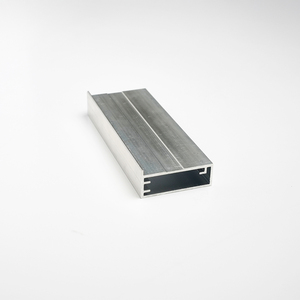
Foshan Aluvoy Entry Door Systems Co., Ltd. engineers specialized architectural door solutions that directly solve these environmental failure modes. Utilizing primary, non-recycled Al-Mg-Si 6063-T6 aluminum alloys, our extrusions feature precise magnesium and silicon ratios (Mg 0.45-0.9%, Si 0.2-0.6%) subjected to artificial aging processes. This structural chemistry achieves an ultimate tensile strength exceeding 205 MPa and a yield strength of 170 MPa, providing structural resistance against typhoon-force design pressures encountered across coastal Aichi.
Advanced Surface Finishing Technologies for C5-M Environments
To ensure long-term performance under ISO 9223 Category C5-M (Marine) and C5-I (Industrial) atmospheric exposures, Aluvoy deploys two core surface treatment technologies:
Targeted Architectural Applications Across Nagoya & Aichi
Tailored door engineering for coastal infrastructure, high-tech manufacturing cleanrooms, commercial hubs, and luxury residences.
1. Nagoya Port Coastal Logistics & Warehousing Hubs
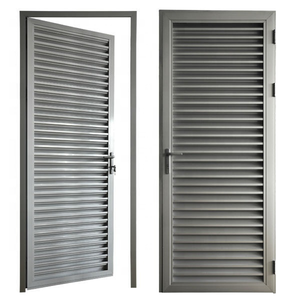
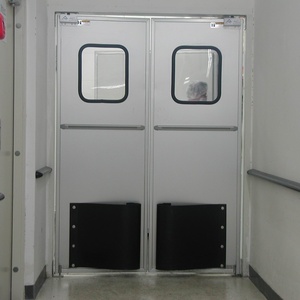
Distribution centers along the Meiko Highway and Port of Nagoya experience constant saltwater airborne fog and heavy freight cycling. Aluvoy lightweight corrosion-resistant swing doors and louver security panels utilize 316-grade stainless steel pivot assemblies and EPDM perimeter seals. This prevents moisture ingress during monsoon conditions while enduring tens of thousands of opening cycles per year.
2. Automotive & High-Tech Cleanrooms (Toyota Supply Cluster)
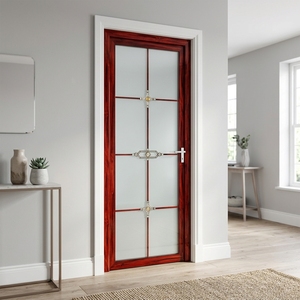
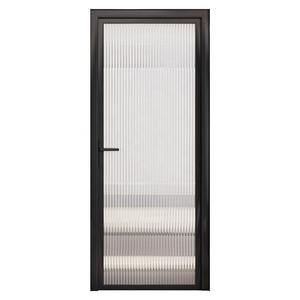
Within the intensive industrial belts of Toyota City, Kariya, and Komaki, automotive suppliers require strict environmental isolation. Our non-outgassing aluminum glass swing doors and airtight hinged systems preserve cleanroom pressure differential boundaries. Smooth anodized surfaces resist industrial solvents, oils, and airborne particulate accumulation.
3. Commercial Malls & Transit Hubs in Sakae & Meieki
High-density commercial districts like Naka Ward (Sakae) and Nagoya Station (Meieki) demand entryways that merge architectural aesthetics with public safety. Aluvoy commercial sliding entry doors incorporate concealed heavy-duty automatic operators, laminated security glass, and slender aluminum sightlines that comply with Japanese public barrier-free access standards.
4. Coastal Luxury Residential & Villa Developments (Chita Peninsula)
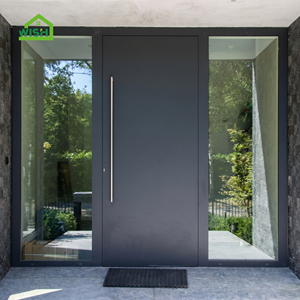
For custom residential villas overlooking Chita Peninsula, architects require massive glass openings that connect indoor and outdoor spaces. Aluvoy modern manual pivot doors and thermally broken sliding systems feature heavy-duty rolling hardware capable of supporting 400kg panels while maintaining light, effortless manual operation.
Alignment with Japanese Building Regulations & ZEH Energy Trends
Harmonizing CE International Directives with Japan Building Standard Law (BSL), JIS A 4702 structural criteria, and Chubu regional energy codes.
Thermal Break Technology & Zero Energy House (ZEH) Performance
The Ministry of Land, Infrastructure, Transport and Tourism (MLIT) in Japan has progressively tightened building energy efficiency standards. Across Aichi Prefecture (Climate Zone 6), achieving compliance with Zero Energy House (ZEH) standards mandates door systems with ultra-low thermal transmittance (U-factor values below 1.6 W/m²K). Aluvoy integrates multi-chambered polyamide barrier strips (Technoform PA66GF25) into our extruded aluminum door frames. By thermally isolating the exterior aluminum profile from the internal structure, thermal bridging is eliminated, preventing winter condensation inside heated interiors and minimizing summer air conditioning loss.
Seismic Resilience & Structural Typhoon Wind Load Engineering
Situated within the Nankai Trough seismic watch zone, Nagoya infrastructure demands structural elasticity. Standard rigid door framing under earthquake movement suffers severe frame distortion, glass fracturing, and mechanical jamming. Aluvoy structural door systems incorporate elastomeric perimeter expansion gap engineering and float-mounted glazing gaskets capable of absorbing lateral inter-story displacement racking angles up to 1/150 without structural failure.
Furthermore, during the Pacific typhoon season, coastal Chubu experiences design wind pressures exceeding 2,400 Pa. Our CE-certified doors are verified through rigorous wind pressure testing (conforming to JIS A 4702 S-5 grade performance), ensuring complete structural integrity during extreme weather events.
Engineering Specification Matrix: Aluvoy vs. Standard Export Doors
| Performance Parameter | Aluvoy CE-Certified Marine Series | Standard Commercial Doors | Nagoya Architectural Relevance |
|---|---|---|---|
| Base Alloy Grade | Primary 6063-T6 Architectural Profile | Recycled Low-Grade Aluminum | High structural yield strength; zero internal purity defects |
| Surface Protection | Qualicoat Class 2 PVDF / AA25 Anodized | Standard Mill Finish / Powder Coating | Resists severe saline breeze & Chubu industrial atmospheric sulfur |
| Salt Spray Resistance | 3,000+ Hours ASTM B117 NSS Tested | 500 - 1,000 Hours Standard | Essential for projects within 3km of Nagoya Port & Ise Bay |
| Thermal Insulation | U-Factor < 1.6 W/m²K (PA66GF25 Strip) | Non-Thermal Break (U-Factor > 3.5) | Fully satisfies Japanese ZEH & Aichi Region 6 energy codes |
| Acoustic Attenuation | Rw 38 dB to 42 dB Glazing Seal | Rw 22 dB - 25 dB Standard | Blocks noise pollution along busy Nagoya elevated expressways |
| Seismic Inter-Story Drift | Compliant up to 1/150 Racking Angle | Rigid Joint Failure at > 1/300 | Mitigates damage caused by seismic activity along the Nankai Fault |
Frequently Asked Questions for Nagoya Procurement Managers
Detailed answers regarding certifications, local code compatibility, custom shop drawings, and shipping logistics.
How do Aluvoy’s CE-certified aluminum doors harmonize with Japanese JIS standards and local Aichi building codes?
Our aluminum door systems are tested under European Standard CE directives (EN 14351-1), which cover air permeability, water tightness, structural wind resistance, and thermal insulation. For Japanese general contractors and developers in Nagoya, we provide cross-referencing technical dossiers that map CE test metrics directly to Japanese Industrial Standards (JIS A 4702 for door sets). Our engineering team can also supply project-specific load calculations to satisfy local Aichi Prefecture building inspectors.
What specific surface finish is recommended for door projects located directly along the Nagoya Port waterfront?
For installations within 3 kilometers of Nagoya Port or Ise Bay, we strongly recommend our Qualicoat Class 2 Fluorocarbon (PVDF) 3-Coat System or our AA25 Anodized Surface Finish. Both surface treatments exceed 3,000 hours of continuous ASTM B117 neutral salt spray testing. This guarantees that the door frames will not suffer from pitting, chalking, or filiform corrosion under continuous exposure to marine sea fog and salt spray.
Can Aluvoy fabricate aluminum doors based on custom Japanese architectural drawings and opening schedules?
Yes, 100% of our production is customized to order. Upon receipt of your architectural CAD drawings or opening schedule, Foshan Aluvoy’s senior engineering department generates comprehensive Auto CAD and 3D BIM shop drawings. Production only commences after formal written sign-off and approval of the shop drawings by the client's project architect or general contractor.
What is the typical shipping lead time and customs clearance route when exporting aluminum doors to Nagoya Port?
Standard manufacturing lead time at our Foshan facility ranges between 25 to 35 days depending on profile finish and glass specification. Ocean sea freight directly from Nansha or Shenzhen Port to the Port of Nagoya typically takes only 5 to 7 days in transit. We provide full export documentation including Certificate of Origin (Form E / RCEP), CE declaration of performance, commercial invoices, and packing lists to facilitate seamless Japanese customs clearance.
How are large door panels packaged to prevent physical damage and corrosion during sea transit?
Export packaging is a critical quality control phase. All door frames are individually wrapped in protective anti-scratch film, cushioned with high-density EPE foam corner protectors, and sealed in moisture-vapor barrier plastic bags with industrial desiccant packs. The entire unit is enclosed within fumigated ISPM-15 compliant solid wooden crates or reinforced steel-frame pallet boxes engineered for safe container unloading via forklift.
What warranty protection is provided for commercial door orders shipped to Japan?
Foshan Aluvoy provides a 10-Year Comprehensive International Structural Warranty covering aluminum frame extrusions against manufacturing defects, structural cracking, and abnormal finish fading. Anodized and PVDF surface finishes carry localized coating guarantees, while German-engineered multi-point locking hardware and roller mechanisms carry a 5-year operational warranty. Replacement hardware or components are dispatched via expedited air transport should any warrantable issue arise.
Why Global Procurement Leaders Partner with Foshan Aluvoy
Combining world-class manufacturing scale with rigorous multi-stage quality control.
Established in 2005, Foshan Aluvoy Entry Door Systems Co., Ltd. has grown into a premier manufacturer and international exporter of high-performance aluminum window and door systems. Operating out of a state-of-the-art 20,000 square meter manufacturing plant staffed by over 150 skilled engineers and fabrication specialists, Aluvoy operates two dedicated automated production lines equipped with multi-axis CNC machining centers, precision automatic double-head miter saws, and pneumatic corner crimping machinery.
Our commitment to manufacturing perfection is reflected in our global compliance portfolio. Aluvoy was among the earliest Chinese manufacturers to secure authentic SAI Global AS2047 accreditation for the Australian market, alongside North American NFRC certification and Florida Hurricane Product Approval for impact-resistant structural profiles. Every aluminum door system engineered for export undergoes complete internal quality assurance (IQA):
- Raw Material Verification: Optical emission spectrometer analysis verifies 100% pure 6063-T6 aluminum billet alloy composition prior to profile extrusion.
- CNC Precision Machining: Computer-controlled milling ensures hardware mortises, hinge notches, and drainage weeping slots are machined to sub-millimeter tolerances (±0.2mm).
- Dual-Component Structural Gluing: Corner joints are mechanically crimped and injected with two-part polyurethane corner adhesive to guarantee absolute frame rigidity and lifetime water tightness.
- Pre-Shipment Factory Mock-Up Assembly: Every custom commercial order undergoes test assembly on factory rig frames to check lock engagement, roller smoothness, and seal compression prior to packing.
Six-Step Project Execution Workflow
A streamlined, risk-free engineering protocol for overseas developers and contractors managing projects remotely.
Plan & Drawing Review
Submit architectural elevations, door schedules, and regional performance requirements to our technical sales team.
Engineering Proposal
Our engineers recommend optimal profile series, glass build-ups, thermal breaks, and surface finishes tailored to budget and building code.
CAD Shop Drawings
Detailed architectural CAD shop drawings featuring exact dimensions, anchorage details, and cross-sections are issued for approval.
Precision CNC Fabrication
Upon sign-off, extrusion cutting, CNC machining, surface coating, dual-component corner gluing, and assembly take place in our factory.
Multi-Stage QC & Crating
Final inspection reports and video documentation are provided to the buyer before heavy-duty export wooden crating and container loading.
Delivery & On-Site Support
Direct ocean shipment to Nagoya Port supported by detailed installation manuals, hardware exploded diagrams, and remote technical help.
Ready to Engineer Your Nagoya Door Project?
Connect directly with Aluvoy's Senior Architectural Engineering Team. Receive technical consultations, custom shop drawings, and factory-direct pricing within 24 business hours.